|
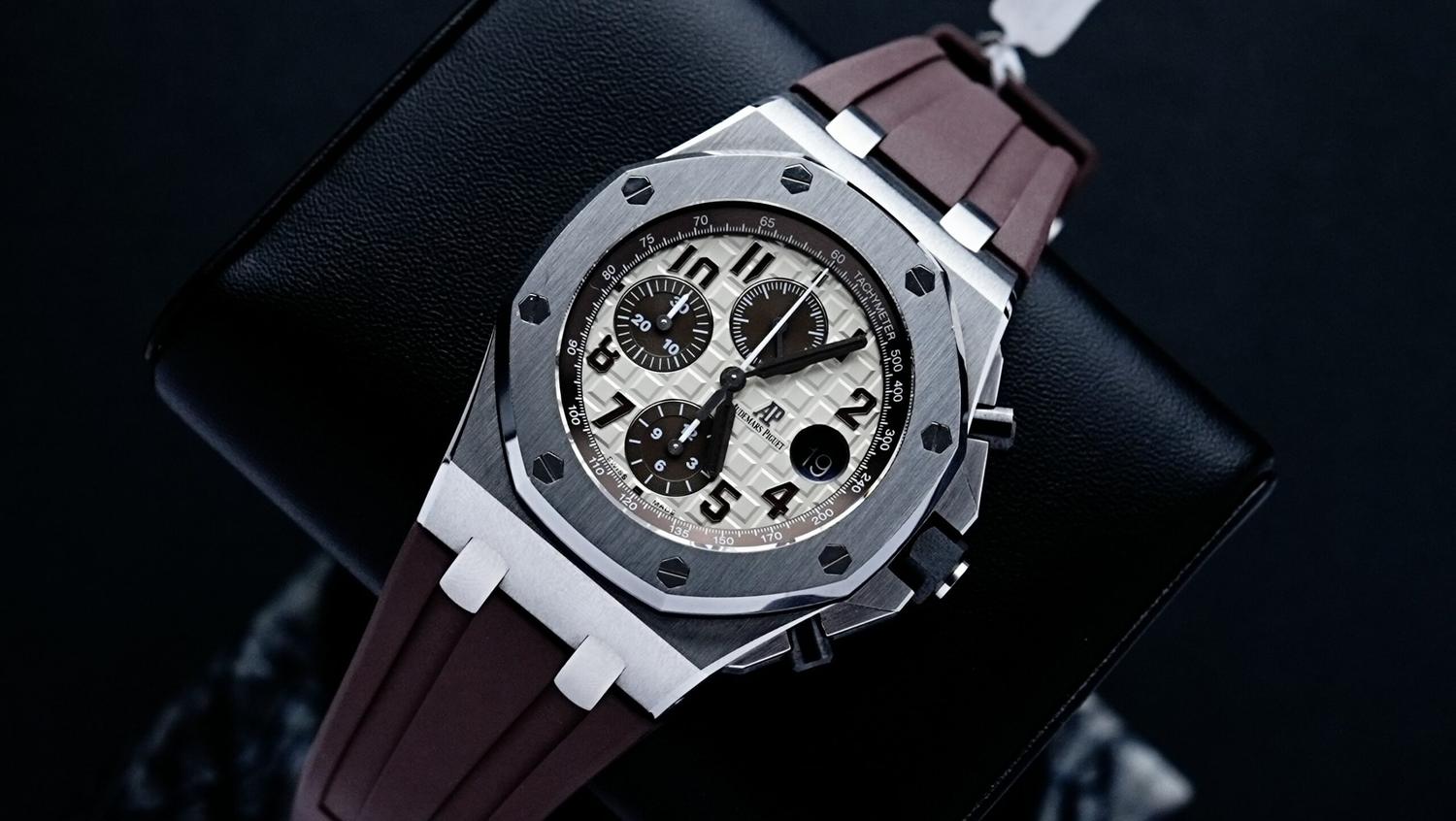
Audemars Piguet Royal Oak Offshore Safari Stainless Steel with Ceramic Pushers, Ivory Clous de Paris “Méga Tapisserie” Dial with Arabic Numeral Hour Markers and Havana Brown Counters and a Tachymeter Scale, Stainless Steel Octagonal Bezel, Self-Winding AP Calibre 3126/3840 Chronograph Automatic Movement with Variable Inertia Blocks Balance Spring and Oscillating Weight with Ceramic Ball Bearings (It’s rhodium-plated, with fausses cotes embellishment. It’s constructed with 54 jewels, 365 components, bi-directional winding, inverted snailing on the bridges with diamond-graved bevels, a shock absorber device, and a straight-line lever escapement. It includes a monometallic balance that’s adjusted to heat, cold, isochronism and 5 positions, a self-compensating flat balance spring with variable inertia blocks, a stop balance for precision time setting, and a monobloc 22-carat gold rotor oscillating weight with ceramic ball bearings. It has a balance-spring stud-holder with a screwed mobile stud, and the mechanism oscillates at a frequency of 21,600 vph (3Hz)). Fitted on a bespoke brown rubber strap with a stainless steel tongue buckle, 42mm
Founded by Jules Audemars and Edward Piguet in 1875, Audemars Piguet took to the challenge of creating timepieces that combine elegance with mechanical ingenuity. With the launch of Audemars Piguet Royal Oak Offshore, the brand proved it did not lose sight of that mission. Considered its most popular model, it is no surprise that the Royal Oak Offshore came out with special models that are extremely coveted among collectors worldwide.
Among the luxury Swiss watchmaking triumvirate that also includes Patek Philippe and Vacheron Constantin, Audemars Piguet undoubtedly pushes the boundaries of design and innovation furthest.
It’s not unfair to say that Audemars Piguet Royal Oak Offshore is one of the most iconic watches ever made. Designed in 1972 by Gerald Genta, the Royal Oak completely changed the way that we look at a steel sports watch. For the first time, stainless steel was treated as a precious metal - receiving complex finishing techniques of brushing, polishing, and beveling - all by hand. The idea that its eight hexagonal bezel screws would be finely finished and left exposed for the wearer to see was a revolutionary thought. It’s no reason that the model became the calling card for the family owned Audemars Piguet - not to mention one of the most sought after watches in the world.
|